


Silicon in Plants: Research Library
Silicon is not classed as an essential plant nutrient, yet it is one of the most studied beneficial elements in plant science. Plants can only take it up as monomeric orthosilicic acid (Si(OH)₄). This library summarises independent, peer-reviewed research on silicon in plants, grouped by topic.
Please note: these studies were carried out by independent researchers with various silicon sources. Unless stated otherwise, they did not test Gen200 Control. The findings describe what each study observed and are not product claims. For Gen200’s own trials, see Gen200 Control field trials & crop comparisons.
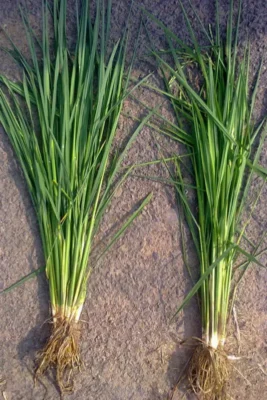
Rice plants and roots from a Gen200 comparison. Silicon is taken up by plant roots as orthosilicic acid.
Foliar application of stabilised silicic acid
Two Brazilian field studies tested a stabilised silicic acid product (Silamol) applied to the leaves.
Leaf application of silicic acid to white oat and wheat
Soratto, R.P., Crusciol, C.A.C., Castro, G.S.A., Costa, C.H.M. & Ferrari Neto, J. (2012). Revista Brasileira de Ciência do Solo, 36, 1538–1544.
- What was tested: Leaf spraying with 2.0 L/ha of a stabilised silicic acid product (0.8% soluble Si), split over three applications, versus an untreated control; irrigated white oat and wheat, Brazil, 2008.
- Key finding: Silicon leaf application raised grain yield by 34% in white oat and 26.9% in wheat, and increased silicon and potassium concentrations in the leaves.
Yield, tuber quality and disease incidence in potato after silicon leaf application
Soratto, R.P., Fernandes, A.M., Crusciol, C.A.C. & Souza-Schlick, G.D. (2012). Pesquisa Agropecuária Brasileira, 47(7), 1000–1006.
- What was tested: Three field experiments with 2 L/ha of a stabilised silicic acid product (0.8% soluble Si), split over four applications, versus an untreated control.
- Key finding: The authors report higher tuber yield and tuber dry matter with silicon leaf application, and lower severity of late blight and incidence of blackleg.
Foliar-applied soluble silicon and powdery mildew of zucchini
Tesfagiorgis, H.B. & Laing, M.D. (2011). African Journal of Agricultural Research, 6(10), 2243–2248.
- What was tested: Soluble silicon (250–1000 mg/L) sprayed on zucchini 1–3 times per week, with and without runoff reaching the root zone.
- Key finding: Silicon sprays reduced powdery mildew severity; more frequent application and runoff reaching the roots gave the best results.
- Read the study (DOI 10.5897/AJAR10.695)
Foliar applications of silicon fertilisers and powdery mildew in greenhouse cucumber
Wolff, S.A., Karoliussen, I., Rohloff, J. & Strimbeck, R. (2012). Journal of Food, Agriculture & Environment, 10(1), 355–359.
- What was tested: Two commercial silicon products applied to the leaves of greenhouse cucumber at different concentrations and frequencies.
- Key finding: All treatments lowered powdery mildew infection compared with the untreated control; the most effective treatment reduced disease severity by up to 87%.
Silicon in plants: cell walls and structure
Effect of silicon deficiency on secondary cell wall synthesis in rice leaf
Yamamoto, T. et al. (2012). Journal of Plant Research, 125, 771–779.
- What was tested: Rice seedlings grown in hydroponics with or without 1.5 mM silicic acid.
- Key finding: Without silicon, leaf blades drooped and the plants built more cellulose and lignin in their cell walls, which indicates that silicon plays a structural role in the leaf.
- Read the study (DOI 10.1007/s10265-012-0489-3)
Silicon and drought and UV stress
Silicon and water relations and photosynthesis of wheat under field drought
Gong, H. & Chen, K. (2012). Acta Physiologiae Plantarum, 34, 1589–1594.
- What was tested: Silicon application to wheat under field drought conditions.
- Key finding: Silicon improved leaf water content and water potential and increased net photosynthesis during most of the day under drought.
- Read the study (DOI 10.1007/s11738-012-0954-6)
The silicon transporter gene Lsi1 and UV-B stress in rice
Fang, C.-X. et al. (2011). Plant Growth Regulation, 65, 1–10.
- What was tested: Rice lines with suppressed or overexpressed Lsi1, the gene responsible for silicon uptake, exposed to increased UV-B radiation.
- Key finding: Higher Lsi1 expression increased silicon uptake and switched on genes related to stress tolerance and photosynthesis.
- Read the study (DOI 10.1007/s10725-011-9569-y)
Silicon sources and plant health in rice
Effect of silicon sources on rice diseases and yield in Tocantins, Brazil
Santos, G.R. et al. (2011). Acta Scientiarum. Agronomy, 33(3).
- What was tested: Three silicon sources (powder, granular, liquid) at six rates on silicon-deficient lowland soils.
- Key finding: Calcium silicate reduced brown spot and panicle blast and increased yield, while calcium-magnesium silicate and potassium silicate did not, which shows that the silicon source matters.
- Read the study (DOI 10.4025/actasciagron.v33i3.6573)
Silicon and manganese and defence enzymes in rice against brown spot
Silva, M.R.J. et al. (2012). Tropical Plant Pathology, 37(5), 339–345.
- What was tested: Rice grown in nutrient solution with or without silicon at three manganese rates, inoculated with the brown spot fungus.
- Key finding: Silicon supply changed the activity of defence-related enzymes (POX, PPO, PAL) after inoculation, depending on the manganese rate.
Silicon in soil and agriculture
Impact of agriculture on the silicon biogeochemical cycle
Keller, C., Guntzer, F., Barboni, D., Labreuche, J. & Meunier, J.-D. (2012). Comptes Rendus Geoscience, 344, 739–746.
- What was tested: Review of the silicon cycle plus new field data on straw removal.
- Key finding: Removing straw from fields can deplete the soil’s pool of plant-derived silicon (phytoliths) within about 10 years, which can reduce the silicon available to future crops.
- Read the study (DOI 10.1016/j.crte.2012.10.004)
Further reading
Fernández, V. (2013). Foliar nutrition of crops: facts, myths and perspectives. New AG International. A practical overview of how foliar fertilisers are taken up by leaves and which factors determine their effectiveness.
From research to practice
Gen200 Control supplies silicon as stabilised orthosilicic acid. See the Gen200 field trials, read how to use Gen200 Control or order a sample pack.
 English